
June Weddings: Theology & Three Martyrs for Marriage
July 13, 2026
June weddings are everywhere — on billboards, venue schedules & social media feeds — often driven by weather, tradition & romance. You either attended a June wedding last month (like me) or know someone who did. Remarkably, June also stands out on the Catholic Church’s calendar: it features feast days that highlight this sacrament’s fidelity, when the witness goes beyond ceremony & becomes as costly as martyrdom. Scripture is also filled with wedding accounts, marital imagery & analogies used to describe God & His people in the Old Testament; & fulfilled in Christ, the Bridegroom & His love for His Bride, the Church, in the New. So, even when weddings are viewed as a social custom, they are always a signpost to a deeper story: marriage has never been a human-derived arrangement, but a “mystery” written into creation by God & completed in Christ.
Marriage: The Bible’s Bookends & More
Scripture both begins with marriage & concludes with a wedding: it “begins with the creation of man and woman” & ends in “the wedding-feast of the Lamb” (CCC 1602). This means the Bible does not treat marriage as a side theme — it uses marriage as one of its most luminous conveyors of God’s plan & God’s love. That analogy is not only poetic. It’s sacramental. The Catechism teaches that the marital covenant — “a partnership of the whole of life”— has an order “to the good of the spouses” & to children & that for baptized people, it has been raised by Christ to the dignity of a sacrament (CCC 1601).
So, when June is associated with weddings, Christians are invited to ask: what if the season’s symbolism is providential? What if month-long wedding celebrations are meant to awaken us to a biblical architecture in which marriage points to Christ & His Church — & to the significance of covenantal love as revealed in Scripture, a significance boldly reinforced by the blood of a few holy martyrs whose feast days we celebrated this very month?
Saints in June: Fidelity to God’s Plan for Marriage Becomes Martyrdom
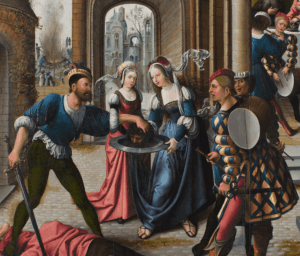
Providentially, June also commemorates the feast days of saints whose lives reveal that love can demand the ultimate sacrifice — as in true discipleship. Two June feast days honor three martyrs who died defending the sanctity of marriage, namely St. Thomas More & St. John Fisher, (combined feast day on June 22), as well as St. John the Baptist (his Nativity feast day on June 24). The former two famously refused to recognize & bless King Henry VIII’s divorce & remarriage, which the King was using as a pretext to break away from Holy Mother Church & establish his own Church of England. Similarly, John the Baptist drew the ire & subsequent vengeance of Herodias because he had spoken out against the marriage of Herodias & Herod, since Herod had unlawfully married Herodias, who was his niece & the former wife of his half-brother.
Martyrdom — when it occurs in fidelity to Christ — becomes the extreme form of that covenant truth: love & fidelity that do not abandon their promise even when threatened with death. These three men were willing to lay down their lives to speak the truth to protect God’s plan for marriage rather than deny this divine institution & its unchangeable, ordained participants & its significance. All three of them knew God’s divine truth about the Sacrament of Matrimony through their deep, abiding faith & by studying & understanding Holy Scripture as the Church interprets it (well, for two of them at least, when there was an established Church). On the scaffold, St. Thomas More maintained his renowned serenity, famously declaring, “I die the king’s good servant, but God’s first.”
Would you be willing to die to defend God’s plan for marriage? Would I? No doubt we all die a white martyrdom when those we love accuse us of being hateful, narrow-minded, or bigoted, especially when defending conjugal, sacramental marriage in today’s culture. But to actually be put to death?
Adam & Eve: The “One Flesh” Structure of Covenantal Love
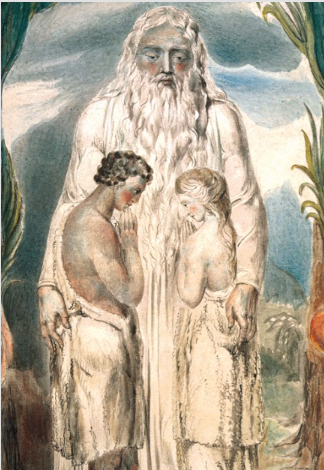
The scriptural thread begins at creation. Mulieris dignitatem (JPII’s apostolic letter, “On the Dignity & Vocation of Women”) returns again & again to the biblical “unity of the two”: from the beginning, man & woman are not meant to remain solitary. The human couple becomes a communion — “for this reason leaving… and… cleaving… so that… they become ‘one flesh’” (Mulieris dignitatem 6).
Genesis 2:24 states the fact in plain, unromantic terms: a man leaves & clings, “and they become one flesh.” This matters because it corrects a common assumption: modern culture often treats romance as a private feeling that can be redesigned at will. The biblical starting point is different. The “one flesh union” is not merely chemistry; it is a covenant shape — a mutual belonging expressed in a lifelong partnership.
Cana: Jesus Begins His Public Ministry by “Entering” Marriage
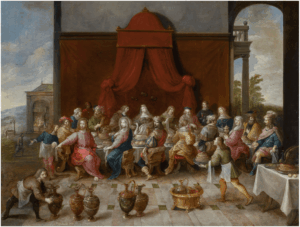
We know that Jesus’ first public sign occurs at a wedding feast. In John’s Gospel, Jesus & His disciples are invited to the wedding at Cana; when the wine runs out, Mary tells the servants to do whatever He tells them. Jesus performs the miracle, revealing His glory & the disciples believed in him (Jn 2:1-11).
This setting is not mere background scenery. The Church attaches “great importance” to Jesus’ presence at Cana: it confirms the goodness of marriage & proclaims that, henceforth, marriage will be an “efficacious sign” of Christ’s presence (CCC 1613). In other words, Jesus does not treat weddings as trivial. He treats them as the kind of place where the heavenly Bridegroom’s work can become visible.
Revelation: the Bible Ends the Way It Began — At a Wedding
If scripture opens with “one flesh,” it ends with the “marriage of the Lamb… and his Bride” (REV 19: 6-9). The Bible places this culmination at the end of salvation history: the nuptial covenant between God & His people prepares for “the new and everlasting covenant,” which culminates in the ultimate wedding feast (CCC 1612). A biblical summary in one line might be: the story is not about individuals getting what they want, but about Christ giving of Himself, our response in receiving Him & His bringing His people into full communion.
Marriage Imagery for Jesus & His Bride
The exact frequency of marriage imagery throughout the Bible is well beyond the scope of this blog, but suffice it to say that the Bible’s overall thematic structure is unmistakable: marriage imagery frames the canon at major turning points (creation, Jesus’ public ministry, wisdom/poetry & final consummation). The Catechism explicitly summarizes that marriage & its “mystery” appear throughout salvation history — its institution, meaning, origin, end, renewal & fulfillment in Christ & the Church (CCC 1602).
Mulieris dignitatem 29 makes the connection between Genesis & the spousal language found in Christ’s relationship to the Church. Pope St. John Paul II explains that the relationship between Christ & the Church in Ephesians (Bridegroom & Bride) connects back to Genesis’ creation of man & woman—making marriage not only a social bond but a sign that reveals divine love, as the primordial sacrament instituted by God. In that spousal analogy, Christ is Bridegroom—He is the one who loves—& the Church is Bride—she is loved & receives love in order to love in return.
Consent & Covenant: Love That’s Lifelong
Weddings, whatever the time of year, may be social events, but the Catholic Church views them through the lens of covenant theology. The Catechism teaches that the parties to the marriage covenant are a man & a woman who are free to marry & who freely express their consent — “to be free” means not being under constraint & “not impeded by natural or ecclesiastical law.” And again, the Church describes the marriage covenant as an intimate communion of life & love, founded by the Creator & ordered to the good of the couple & the generation & education of children; for baptized persons, Christ raises it to sacramental dignity (CCC 1625). That sacramental lens changes how we think about what a wedding truly signifies. It isn’t merely a moment; it’s the beginning of a covenant that claims the whole of life.
Theology of the Body & Marriage
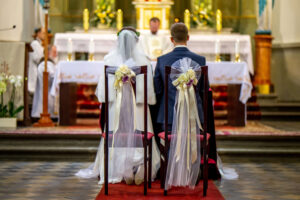
Pope St. John Paul II’s Theology of the Body begins at the threshold of the biblical account in Genesis — because Christ’s teaching also returns to “the beginning.” In that approach, theology is not ashamed of the body; it treats the Incarnation as the reason the body enters Christian theology “through the main door.” The key practical implication for weddings & marriage is that Christian couples are called to live the “spousal meaning of the body,” because what shapes married life must have its full personal dimension “in shared life, in behavior, in feelings” (TOB 23:1-5). Therefore, weddings are not only about vows spoken in a church; they are about learning a language of the body that corresponds to the covenant reality marriage signifies.
June Weddings: An Interior Summons
If June makes weddings seem trite, His word & His Church push us toward something extraordinary: they identify marriage as a sacrament or sign of Christ’s covenantal love for His people, a covenant begun in creation & expressed powerfully in Christ’s first public miracle at Cana.
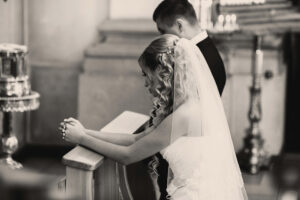
So, whether you walked into a wedding chapel last month or simply observed more matrimonial posts of flowers, three-tier cakes, & white dresses, the Catholic invitation is the same: let the wedding season become an interior summons — toward truth in love, toward a sacred covenant, toward the ultimate sacrifice of three esteemed saints & toward the hope that the story ends, not in tragedy, but in the wedding feast of all wedding feasts for all of the faithful through the mercy of God.

Written by, Evie Estes,
Curriculum Production Manager,
Editor, Sales & Website Support
Artwork:
The Angel of the Divine Presence Clothing Adam and Eve with Coats of Skins. William Blake. 1803.
The Martyrdom of St. John the Baptist. Bernard van Orley. 1514-1515.
The Wedding Feast at Cana. Frans Francken the Younger. 1600s.
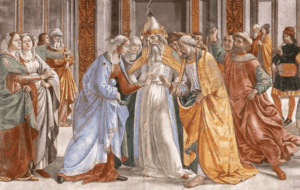
Marriage of Mary. Domenico Ghirlandaio. 1486-1490.
Share