
Introducing the Letter to the Ephesians
August 12, 2026
In Part Two of Theology of the Body (TOB), Pope St. John Paul II focuses on the sacrament of marriage and on sexual ethics. A large portion of this material is inspired by the fifth chapter of St. Paul’s Letter to the Ephesians (Eph 5:21-33). If you have not read this passage in a while, I encourage you to take out your bible and read it now. You might want to bookmark it since we will refer back to it regularly as we explore Part Two of TOB.
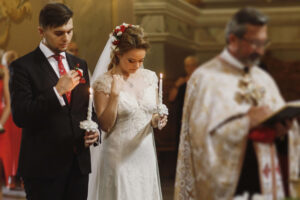
Previously, the late pope meditated on Christ’s words in the gospels on the “beginning,” his appeal to the human heart, and his words about the future resurrection. He saw St. Paul’s text from Ephesians 5 as the “crowning” of this series of biblical passages about the human person. He based his reflections on marriage on this passage but in doing so also “presupposed” the theology of the human person he had developed from those prior Scriptural texts. In other words, John Paul II believed that in order to interpret Ephesians 5 correctly, “one must do so in the light of what Christ has told us about the human body” (87.2), including the perspectives of original man, historical man, and eschatological man, which was the focus of Part One of TOB.
Before analyzing the passage on marriage in chapter 5, Pope St. John Paul II overviews the entire Letter to the Ephesians to provide context. St. Paul begins his letter “by presenting the eternal plan of man’s salvation in Jesus Christ” (88.1), which serves as a central theme. The Father’s eternal plan for our salvation was revealed through Christ: we are called to become his adoptive sons and daughters through Jesus who died and rose again to redeem us from sin. He further calls all humanity into the unity of his body, the Church, of which Christ is the head. St. Paul spends the first couple of chapters of his letter reminding the Ephesians of this amazing divine plan for our salvation and giving thanks to God for His unfathomable goodness to us. In doing so, St. Paul models the awe and wonder, humble gratitude, and trust which should characterize our hearts’ response to God’s redemptive love.
Roughly the second half of the Letter to the Ephesians is devoted to outlining how Christians are called to live in response to God’s plan for our salvation. According to John Paul II, we are called “to overcome the vices and acquire the virtues that correspond to the vocation all have received in Christ” (88.2). Indeed, St. Paul admonishes us to “be imitators of God, as beloved children and walk in love, as Christ loved us and gave himself up for us” (Eph 5:1-2). He exhorts us to shun sinful ways: “immorality and all impurity or covetousness must not even be named among you, as is fitting among saints” (Eph 5:3). Rather, we are called to cast off such darkness and walk in the light of Christ, praising and thanking God for His plan for our salvation and faithfully devoting ourselves to holiness of life.
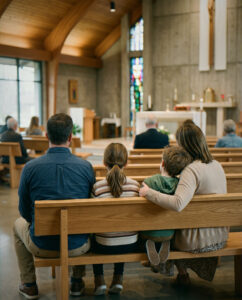
A key theme of this part of Ephesians is unity. First, St. Paul emphasizes and marvels at God’s plan to unite all men — Jew and Gentile — in Christ through the Church. He then exhorts his readers to live in such a way to preserve and strengthen this unity both in the Church as a whole and within the domestic church of the family. He speaks of the duties of spouses, parents and children, and masters and servants. St. Paul concludes with an “encouragement to spiritual battle” (88.5; see Eph 6:10-20) and a blessing.
Thus, according to the late pope, “the two main guiding lines of the whole Letter to the Ephesians” consist in 1.) “The divine plan for man’s salvation,” “which is realized in the Church,” and 2.) “The Christian vocation… of baptized persons and particular communities” corresponding to this plan (88.3). His reflections in TOB focus primarily on the second of these two themes and what St. Paul’s teaching reveals for us about marriage, the human person, and Christian life. We will unpack these reflections, particularly on Ephesians 5:21-33 in the following months.
Note: This article is part of an ongoing series on Pope St. John Paul II’s “Theology of the Body.”
Written by, Dr. Andrew Sodergren, M.T.S., Psy.D.,
Director of Ruah Woods Psychological Services
(Article originally published in The Catholic Telegraph, November 2025 Issue, the official magazine of the Archdiocese of Cincinnati)
Share