
A Father’s One Desire
November 12, 2026

In the Museum of Cluny in Paris, there’s a series of six fifteenth-century tapestries replete with allegorical meaning. The center of each tapestry presents the same rich noblewoman at the entrance of a tent. Clearly, each of the first five giant wall hangings signifies one of the five senses; but for over 500 years people have debated the meaning of the sixth and last tapestry. Enigmatic words are written over the lady’s head: “To my one desire.” She has a hand stretched out toward a treasure box set before her, and for the first time she is smiling. The ruckus is over what the object of her one desire is.
Poets have compared our lives to a tapestry woven thread by thread, day by day. If we apply this image to my father, who passed away this past July, it’s not hard to say what he treasured above all else.

He made his desire plain to my mother over 65 years ago when he proposed to her. Mom says he took her to a disreputable park (something very unusual for him) where couples wrap their arms around each other, “etc.” They were walking there when Dad wrapped his arms around Mom and asked her to help him get to heaven. They had only begun to embrace, as they were just getting to the “etc.” in the park, when a policeman told them to move along.
Turns out there were other suitors in my mother’s life at the time, and she hadn’t settled on any of them yet when my dad proposed. So, I asked her why she accepted. Mom gave me a funny look and said it was because he spoke about the two of them getting to heaven together.
My father’s favorite songs also pointed to his “one desire.” I was about 12 years old when I remember my dad saying he wanted the song “Amazing Grace” sung at his funeral one day. Ever since then, I have never heard that song mentioned without connecting it to his future funeral. Often, this was enough to choke me up.

Fast-forward to two days before Mom and Dad’s 50th wedding anniversary celebration. Dad and I were in the living room trying to pick two songs to perform together. He had just started strumming the tune of “Amazing Grace” on his guitar when Mom called out fiercely from the kitchen: “You’re not going to sing that song for our anniversary because it’s a funeral song!” We laughed. Dad protested. Mom won out.
So, Dad meekly began playing his second favorite song, “How Great Thou Art.” Mom burst out of the kitchen, exclaiming irately, “You’re not going to sing that song either because it’s a funeral song, too!” Coincidentally, that day, we went together to what turned out to be a funeral mass. It was a good thing we were seated at the back, behind all the mourners. We managed to hold back our mirth when “Amazing Grace” was sung, but all three of us succumbed to quiet laughter when the opening chords of “How Great Thou Art” were struck.
Mom is right that these are popular funeral songs, at least where I come from, but they also have meaning for “ordinary life.” Dad wanted them sung at his funeral precisely because they expressed the attitudes he lived by. They both effuse praise and awe at God’s creative goodness and gratitude for his overwhelming mercy.
My father had a very difficult upbringing. There was no lack of money, but my dad didn’t experience his parents’ love and carried a lot of painful baggage into adulthood. He struggled with feelings of unworthiness. Around the time he met my mother, he realized that his misery, weaknesses, failings, and sins were not a problem for God, whose mercy is infinite. From then on, he never stopped feeling amazed and grateful for God’s merciful love.

Dad held fast to the conviction that God was pleased with his one desire for heaven, even as he was acutely aware that he could never measure up to that desire on his own. It could only be a gift from God, an “Amazing Grace.” Our hearts have an infinite desire and cannot be satisfied by anything in this life. Only God, who is infinite, can respond to our longing by filling our entire beings to overflowing. In this way, the depth of our human need meets the depth of God’s mercy, echoing the Psalm: “Abyss calls out to abyss” (Ps 42:7). Dad lived within that very space the psalmist described.
The week before my father passed from this life, he and Mom reminisced about his proposal of marriage. Mom asked him whether she had helped him in his efforts to get to heaven. In answer, Dad wrapped his arms around her and hugged her tightly.
His lifelong quest surfaced once more at the very end. Just minutes before the last thread of the tapestry of my dad’s life was woven, one of my brothers asked my mother how Dad had proposed to her. She told us about the walk in the questionable park, how Dad asked her to help him get to heaven, and then the brief embrace, interrupted by the overly vigilant policeman. At that point, my dad seemed to come out of the stupor he had fallen into. He moved his mouth as if trying to say something, but he was out of air. I think he was trying to tell my mother, “I love you.” One tear gathered in the corner of his right eye, and then he gently expired.
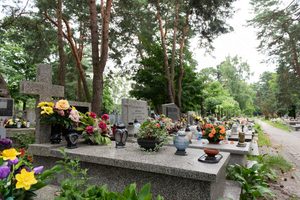
November is a month the Church has set aside to pray for all of the deceased and to contemplate our own death as well. That quiet contemplation always brings to mind one of my favorite Bible passages, easily remembered by the numbers “2-4-6-8”— the 2nd letter to Timothy, chapter 4, verses 6 to 8:
“For I am already being poured out like a libation, and the time of my departure is at hand. I have competed well; I have finished the race; I have kept the faith. From now on the crown of righteousness awaits me, which the Lord, the just judge, will award to me on that day, and not only to me, but to all who have longed for his appearance.”
It’s still so painful that my dad has left this life, but what a consolation to think that he is now, or will soon be, resting in the embrace of the Holy Trinity, where the “etc.” encompasses unfathomable delights and joys, and where no policeman will come up to tell my father to move along.

Written by,
Dr. Joan Kingsland*,
Senior Fellow, Christian Anthropology & Formation
for Ruah Woods Institute
*Joan Kingsland SThD, has been a member of the Society of Apostolic Life, the Consecrated Women of Regnum Christi since 1993. She earned licentiate and doctoral degrees in moral theology at the John Paul II Institute for Marriage and the Family in Rome, as well as a Bachelor of Arts degree from Thomas Aquinas College, and a Master of Arts degree from the Pontifical Institute of Medieval Studies at the University of Toronto. She taught moral theology and Catechetics at Mount St. Mary’s Seminary in Cincinnati from 2016-2018, moral theology at Mater Ecclesiae College in Rhode Island from 2006-2015, and Catholic Faith Formation, grades 5-10 at the Highlands School in Dallas, Texas from 2002-2006. She recently moved back to Cincinnati from Rome where she taught the Social Doctrine of the Catholic Church at Regina Apostolorum Seminary. She is now full-time at Ruah Woods Institute helping in the theology and development of our curriculum, training, and formation for educators K-12, as well as a spiritual leader for our staff.
Image: (Toulouse) Mon seul désir (La Dame à la licorne) — Musée de Cluny Paris
Share