
Unfathomable Human Loss, Limitless Divine Mercy
March 12, 2026
During a pilgrimage to Poland last fall with the TOB Educators collaborative, we spent the first three days at a retreat near the Divine Mercy Shrine. We listened to talks, visited St. Faustina’s burial site, and explored one of the places where Jesus appeared to her. It was a remarkable honor. I felt immersed in Jesus’ love and mercy among all the wonderful people and places we experienced. However, I had no idea what awaited me on our upcoming tour of Auschwitz.
My Mom’s Story
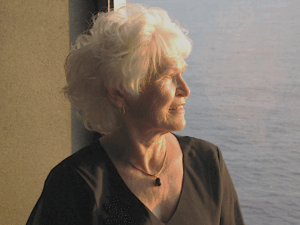
My mom was born in Croatia at the start of WWII. Her family was torn apart as they fled on foot to escape the Nazis. My mom was just a baby and was with her mother and several of her younger siblings when they fled, separated from the older boys and her father. They were scared, hungry, and homeless as they traveled across Eastern Europe looking for safety. There were many times my mom could have died; she lost a brother and a sister to the war. She ended up in a German labor camp that was eventually liberated by the U.S. Army. After the war, they made their way to the United States. Growing up, I heard many stories about my mom’s journey and the atrocities committed by the Nazi and Communist regimes.
Entering Auschwitz
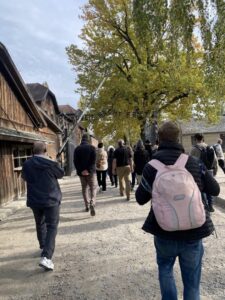
As we entered Auschwitz, I prepared myself to see things that I knew would be difficult for anyone. I tried to forget that my mom and her family were in this area and could have been killed here, but for the grace of God. We saw the inhumane conditions the prisoners were forced to live in and how they died. We heard stories of those who pushed back against Nazi authority and were killed for it. We saw collections of items taken from the prisoners, including dishes, shoes, and hair. I was holding it together until I turned a corner and saw baby clothes and shoes on display. Then, I lost it. How could anyone kill children? What kind of person could do such things? I simply could not understand the evil necessary for all these atrocities. I was deeply heartbroken. In a letter to Henri de Lubac, JPII said, “The evil of our times consists in the first place a degradation, indeed a pulverization of the fundamental uniqueness of each human person.” Each of these individuals was unique, unrepeatable, irreplaceable, and deeply loved by their Creator.
John Paul II teaches us in his Theology of the Body that human persons are distinct from the rest of creation. We are the only creatures made in the image and likeness of God. Every human shares in this image, regardless of race, creed, or religion, and we all possess ontological dignity because of it. “There is no Jew or Greek, there is neither slave nor free, there is neither male nor female; for you are all one in Christ Jesus” (Gal 3:28).
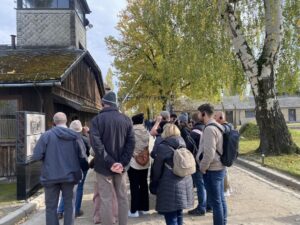
As we walked through the camp, we learned more about the people there—the prisoners and the leaders. We saw the spot where Maximilian Kolbe stepped forward to offer his life for another and the starvation cell where he was held with nine other prisoners. Toward the end of the tour, our guide pointed out the place where Rudolf Höss, a German SS officer and Auschwitz’s longest-serving commandant, was hanged next to the crematorium. He was responsible for the murders of over three million people, mostly Jews, during his time there. Then, the guide told us that after Höss was imprisoned for his crimes—and before he was hanged—he wanted to speak with a priest. He remembered the name of a priest who had come to Auschwitz to visit prisoners and called for him specifically. Höss made a lengthy confession to Fr. Lohn and received absolution. My mind was racing. Was this man really going to heaven? After everything he had done? Over three million people murdered! And then, I was struck with a realization. Shouldn’t I want heaven for everyone—even Rudolph Höss? Isn’t that the main takeaway from Jesus’ parable about the laborers in the vineyard receiving the same wage from a generous landowner, despite how many hours they worked that day? (Mt. 20:1-16). What is happening in my heart? Why does it shake me to the core to think of this man in heaven? I prayed and asked God to help me become the person who desires everyone, even Rudolph Höss, to be in heaven.
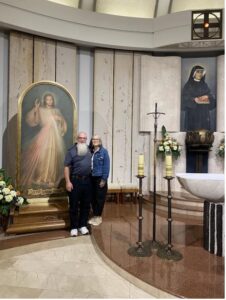
At the beginning of my pilgrimage, I was at the Divine Mercy Shrine, immersed in God’s love and mercy. His boundless love and mercy filled my heart. Now, at Auschwitz, I have encountered this limitless mercy—a generosity of heart I can’t fully grasp—and I realized I needed to repent of my pride, selfishness, and judgment. JPII said that the Paschal Mystery “bears within itself the most complete revelation of mercy… of that love which is more powerful than death, more powerful than sin and every evil, the love which lifts man up when he falls into the abyss and frees him from the greatest threats.” 1 God’s mercy is endless, for everyone! None of us deserves it, not Rudolph Höss, not me. It is a GIFT.
The Prayer of Maximilian Kolbe
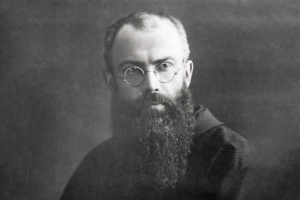
I later learned that Maximilian Kolbe offered his suffering during his time in Auschwitz “for the conversion of all that suffered the horrors of Auschwitz, all his fellow prisoners who were in danger of despairing and cursing God for their plight. And Kolbe had offered his prayer and sacrifice for the Commandant.”2 During his time in solitary confinement, Höss reflected on everything that had happened. He repented and was sorry for his sins. He called for a priest and confessed. Maximilian Kolbe wanted his conversion, and so should I.
As Christians, we need God’s mercy. We should be grateful that His mercy is endless and available to everyone. A reminder of this is the annual feast day, Divine Mercy Sunday, which always falls one week after Easter Sunday, this year on Sunday, April 12, 2026. I have started praying for Höss, as I believe he might be in purgatory and could benefit from our prayers. I also hope that someday people will pray for me as well. Jesus, I trust in You.
Written by, Kathleen Cory,
Sales, Training & Implementation Specialist (South),
Ruah Woods Institute
- Encyclical letter on the Eternal Father, Rich in Mercy, Pope John Paul II
- https://schooloffaith.com/rosary-archive/the-conversion-of-rudolph-hoess
Share