
What is the True Purpose of Catholic Education?
January 13, 2026
Catholic education is not merely about acquiring skills for worldly success; it is a sacred mission to know & glorify God, who created every human — male or female — in His image & likeness. As the Catechism of the Catholic Church (2252) teaches, parents hold the primary responsibility for educating their children in faith, prayer & virtues, fostering a home where community, forgiveness & self-mastery prepare them for true freedom. This formation awakens a well-formed conscience from the earliest years, guarding against selfishness & pride while engendering peace of heart (CCC 1784). Ultimately, education aims at the eternal: delighting in the truth, beauty & goodness subsisting in God, relating all knowledge to the light of faith (The Religious Dimension of Education in a Catholic School: Guidelines for Reflection and Renewal, Congregation for Catholic Education, 1988).
God’s Image & Pursuit of Truth
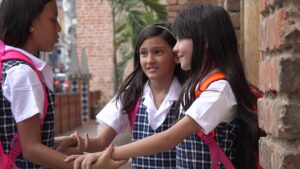
Human beings, made in God’s image (imago Dei), are called to recognize objective reality & respond in accord with it. The mission of education initiates us into this reality, building the Body of Christ through the teaching of doctrine & Christian life (CCC 5). Yet, as noted by authors Michael Ortner & Kimberly Begg in their excellent guidebook, The Catholic School Playbook, “Most modern educators understand mission in utilitarian terms: the aim of learning is not the pursuit of truth and human flourishing, but socialization and preparation for college and the workforce” (pg. 5). This shift pervades curricula, as the guide continues: “For decades, school curricula and methods have evolved to reflect an increasingly secular worldview — one that sees the world through the distorted lens of materialism, progressivism, and the rejection of God and tradition” (pg. 6).
Incompatibility of Utilitarianism & Salvation

Contemporary education’s emphasis on utilitarianism clashes with the Church’s goals for our moral formation & ultimately, salvation. The Catholic School Playbook observes: “The utilitarianism of modern education is incompatible with the salvific goal of the Catholic Church… replacing morality with relativism, wonder with pragmatism, and exploration with test preparation” (pg. 6). Pope St. John Paul II echoed this, rejecting a “totally secular school system” that leaves God “at the schoolhouse door,” urging Catholic schools to transmit a worldview rooted in Creation and Redemption (To Catholic Educators of Newfoundland, September 12, 1984, speech). Increasing the natural sense of awe & wonder, & delight in discovering the order, design & meaning within God’s beautiful plan in every school subject far eclipses mere rote memorization & regurgitation. Students learn how to think & reason, rather than what to think & repeat.
A grave error persists viewing Catholic faith as “a matter of feeling, a matter of private opinion, [having] nothing to do with reason or reality,” per The Catholic School Playbook (pg. 11). This severs heart from mind: “You cannot ultimately have a Catholic heart without a Catholic mind, and our children cannot be expected to live as Catholics if they cannot think and see as Catholics. We do not have a unified vision of Catholic education because we no longer have a Catholic vision of reality — of nature, the human being, and the meaning of history” (pg. 7). When we forget God, we forget our story, we forget who we are & we forget how to live within our given nature with our ultimate end in mind.
Secular Schools & the Catholic Alternative
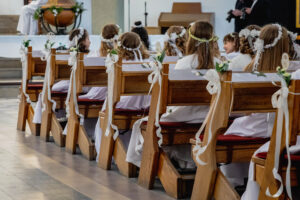
Many public & private schools are “hostile to the faith… that Christianity is anti-science & bigoted, that abortion is healthcare, that gender is independent of biological sex, and that promiscuity among all people, including children and young adults, should be encouraged,” as The Catholic School Playbook (pg. 23) points out. The Church resists such encroachments, defending education’s freedom amid secularism’s threats to marriage & youth formation (Educating to fraternal humanism, 28, Congregation for Catholic Education, 2017).
Catechesis counters this by teaching meditation on Holy Scripture, a true historical Christian Anthropology & God’s ultimate order, design & plan for the human person — essential for purposefully striving to bear the fruits of the Holy Spirit. Pope St. John Paul II in his Message to the National Catholic Educational Association of the United States on April 16, 1979, emphasized, “Catholic education is above all a question of communicating Christ, of helping to form Christ in the lives of others.”
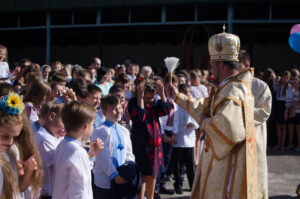
Parents & educators must reclaim this vision. Catholic schools should include ongoing faculty formation, community efforts with families & parishes, evangelization of the culture, while upholding the dignity of every human person from conception to natural death & striving toward the common good of all: sanctity in Christ. C.S. Lewis wrote, “Christianity… if false, is of no importance, and if true, of infinite importance. The one thing it cannot be is moderately important” (God in the Dock: Essays on Theology and Ethics, “Christian Apologetics,” 1970). Catholic education should glorify God by pursuing eternal truth, beauty & goodness across all subjects, rejecting false, misleading secular ideologies. Choose to be & support a local Catholic school that is faithful to this God-ordained, Christ-centered mission — our children’s hearts, minds & souls depend on it.

Written by, Evie Estes,
Curriculum Production Manager,
Editor, Sales & Website Support
Share